

Food courts have come to play a significant role in the contemporary setting, where individuals can unwind, revitalize, and even have a variety of tasty dishes. Regardless of its location, retail places, airports, office buildings, or educational institutions, food court design needs to be expertly planned and constructed to accommodate a wide variety of patrons.
The placement of tables and chairs is not enough to achieve the goal of establishing a food court that is vibrant, lively, contributes to social interaction, increases productivity, and, thus, overall improves the dining experience. The article discusses exemplary ideas in food court design that highlight such aspects as furniture layout, diversity of seats, lighting as well as furniture flexibility and design. These ideas are supposed to enhance client satisfaction, reduce operational challenges, and ensure the region will host large crowds as well as individual events.
Table of Contents
Food Court Design Ideas
1. Cafe Height Tables for Adaptability and Effective Use of Space

Some convenient ways of providing movable seats in a food court design would be to construct tables that are at the height of a cafe. We have big cafe-style tables and chairs that allow customers to stand/sit on instead of the desks and chairs as in workplaces and classrooms. There is no need to have customers sit down and spend long periods of time enjoying a quick meal or snack, this arrangement is highly beneficial in busy environments.
Also, the chairs around these high tables can be in a smaller area, thus giving room to bigger meetings without crowding the area. The seating arrangement also enables more open flow of traffic and relieves congestion during peak periods since it enables more spacing between the tables.
2. Separate Food Windows to Offer Variety

Diversity plays an important role in the current food courts as repetitive food platforms may push out customer numbers. The best food court design concepts include separate food windows, which are similar to mall food courts. Customers are not restricted to one type of food, or one cuisine as each window has a different menu item. Various palates can be appeased by offering multiple food stands.
Examples include having a window with Asian food and another with fast food, salads, or desserts. This design isolates the flow of clients across a few lines that not only makes this design attractive to a broader audience but also hastens service. This design is of great assistance in those locations such as corporate food courts or schools, where consumers might visit regularly and require fresh options.
3. Lounge Seating for a Relaxed Atmosphere

The idea behind this is to welcome the lounge seating such that a food court will feel more akin to a community gathering rather than a functional eating space. Between meals, visitors will be able to enjoy the less strict environment of lounge areas equipped with comfortable seats in form of chairs and couches along with low tables.
This helps them to unwind, socialize, and even to work. This is particularly useful in locations where people might need to spend long durations of time such as at airports, universities or even in a business setting. Such sitting areas may also be used to distinguish a food court as a regular cafeteria because they allow a more relaxed environment in which their customers can enjoy their meal without being in a hurry or feeling overwhelmed.
4. Stackable Chairs and Stowaway Tables for Flexibility

A well-designed food court should be utilized for things other than eating. One of the most reasonable food court design concepts is to use stackable seats and tables that can be folded at the same time. These allow the space to be transformed quickly and easily in order to host a banquet, presentation or an event.
These mobile pieces of furniture have more applications beyond seating diners when they are at peak times. Meetings, gatherings of business or school events can be conducted in the same facility during after-hours. Reconfigurable and stackable furniture will enhance the ease of the food court and the efficiency of operation since one can easily rearrange the space to suit the changes.
5. Meal Options
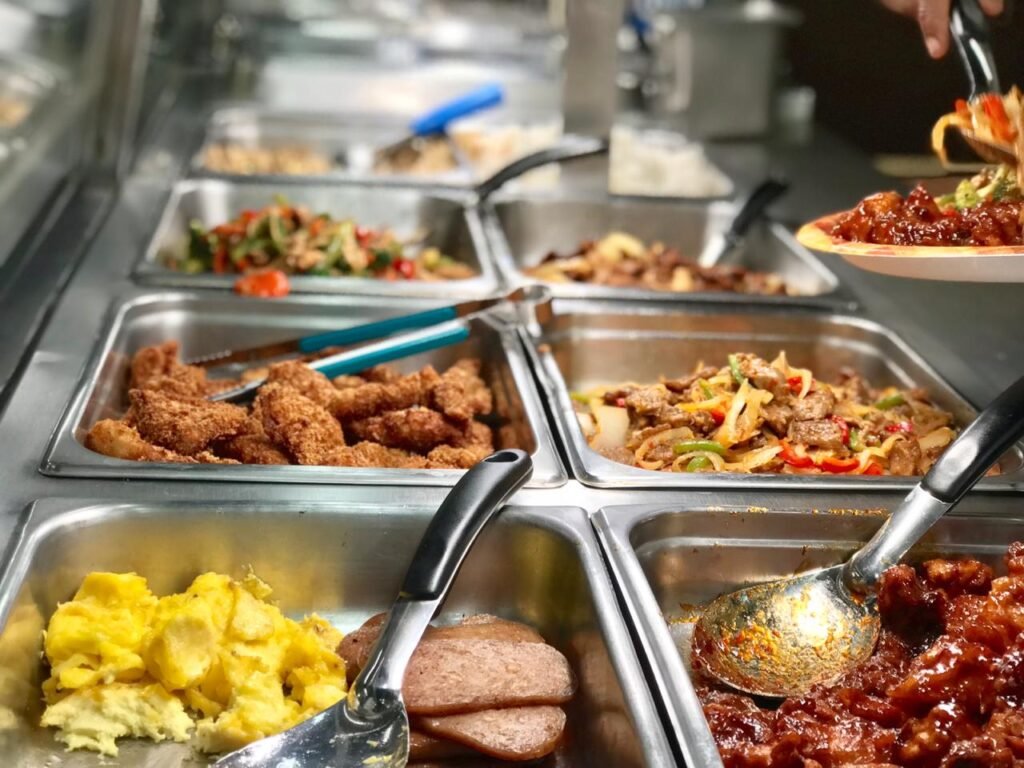
Perhaps in business and educational settings in particular, the practice of creating food courts with snack meal restaurants in mind is increasingly becoming the norm. They also enable the customer to quickly select what he/ she desires without necessarily queuing in a line since these stations have already packed dishes, snacks or beverages. It is also designed in a way that it minimizes the traffic in the old-fashioned food court queue, providing clients with a limited time with quicker service options.
6. Themed Food Courts for Visual Appeal

One of the most ideal food court design concepts is the use of a theme to design an aesthetically pleasing space. Be it within an upscale shopping center, college food court design, or a business office park, a carefully considered theme can contribute some flavor and blend with the overall perception of the area. Food court design based on a natural theme, such as may focus on sustainability, use natural materials, such as wood and stone and decorate with indoor plants. Conversely, futuristic food court design concepts may be dynamically lit, sleek, contemporary, and digital ordering kiosks. Regardless of the topic, it sets a mood that lures customers and makes them have a good impression of the place.
7. Open Kitchens for Transparency

As they allow the patrons to watch how the food is prepared and provide confidence and transparency, open kitchens are increasingly being used to design food courts. Customers like to know that their food is freshly prepared in an open environment that is nice and clean. Open kitchens also add the element of interaction to the dining experience by enabling the patrons to watch the chefs in action behind closed doors. In addition, as the main element of the layout, open kitchens can contribute to the overall visual appeal of the food court.
8. Efficient Lighting for Ambiance

Just like any other design, food courts need to be illuminated as well. It is not an exception. A space’s mood and aesthetic appeal are both improved by appropriate lighting. Warm and dim lighting styles are ideal with casual or fast food court design and bright natural lighting styles are ideal with more relaxed, sit-down settings. Showpiece light fixtures or chandeliers can also be used to provide the room with the look of refined. Also, underneath counters or pathways can be improved by adding LED strip lighting that can enliven the mood, but provide practical benefits such as visibility in the busiest periods.
9. Adding Greenery for a Fresh and Calming Environment

The use of plants in designing any food court is among the most effective ways of developing a relaxing and invigorating environment. Plants and other greenery disrupt the industrial ambiance that encompasses all social areas so that the food court looks cozier and welcoming.
Table displays of little potted plants, hanging gardens, and indoor gardens are all very enjoyable to the eating experience as they add life and color to the room. In addition to being able to make spaces appear nicer, plants also assist in improving air quality, which can then make customers feel more at ease in the environment. To create a serene natural mood, plant trees in strategic spots, along walks or even in the sitting arrangement.
10. Smart Technology Integration for Enhanced Experience

The application of smart technology in the design of a food court can significantly enhance the experience of patrons and their services. Kiosks where people can place their orders via touch-screen, digital menu boards, and pre-ordering via mobile apps are some real-life food court concepts that will minimize waiting time and shorten the ordering process. There will be smart technology to enhance the environment and service. This can be done through interactive digital screens to display menus, daily special offers or even entertain/test consumers with cuisine as they wait.
11. Color Scheme and Decor

The color scheme in a food court makes a significant contribution to the space. Bright and jovial colors such as orange, red, and yellow work well in fast-food facilities because they are often associated with stimulating appetites. There are cases, however, that neutral or pastel colors may be more suitable, such as a company or a fancy food court where a cool collected atmosphere is required.
A personal touch can also be introduced to an atmosphere and even made more familiar with the help of an odd decoration such as paintings, customer murals or personalized signs. Regardless of the style of food court design (formal, informal, avant-garde), the design has to extend the theme and give ambassador status to the brand.
12. Sustainable Design Solutions

Designed food courts these days can not help but consider sustainability. Environmentally friendly flooring, fixtures and furnishings reduce their adverse impacts on the environment without sacrificing style. The design has to incorporate the use of energy-efficient lighting, use water-saving fixtures and recyclable materials. Other methods should be incorporated in the operations of the food court.
Read Next


